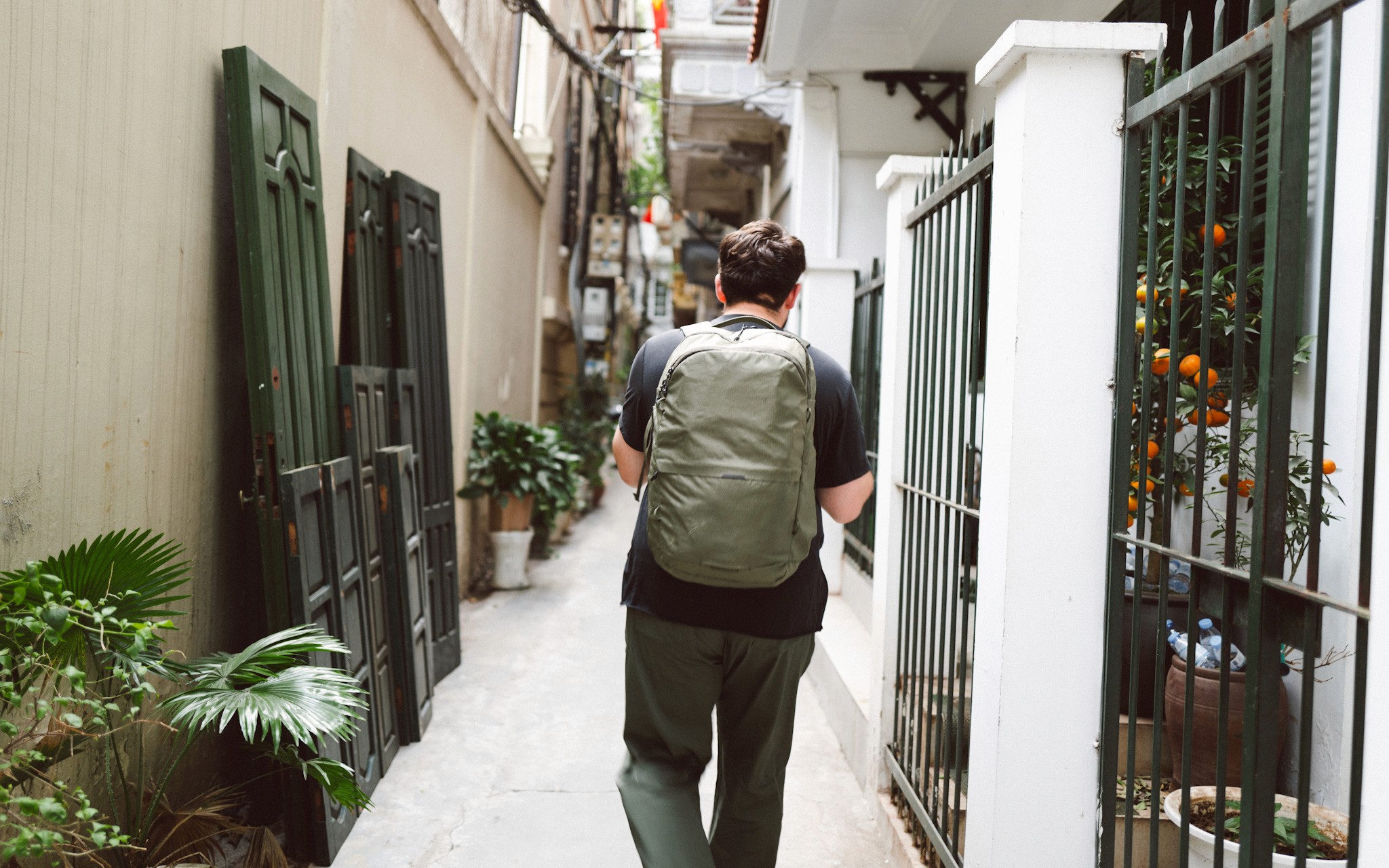
The goal of this study was to conduct real-world, longitudinal testing across Pakt’s carry system to surface insights beyond first impressions. By evaluating the Aero 35L, sling, and tote in active travel conditions—and applying structured analysis to a pre-production duffel—I aimed to identify evidence-based opportunities for refinement, ensuring future iterations improve performance without compromising what already works.
Pakt builds highly considered products, but limited pre-production field testing makes it difficult to understand how designs perform across real-world travel scenarios. While the Aero 35L, sling, and tote were tested in use, the duffel—Pakt’s flagship product—posed a different challenge: how to meaningfully improve something already performing at a high level. Without structured field insights, refinements risk being incremental rather than impactful.
Summary
Goal
Problem
Research Questions
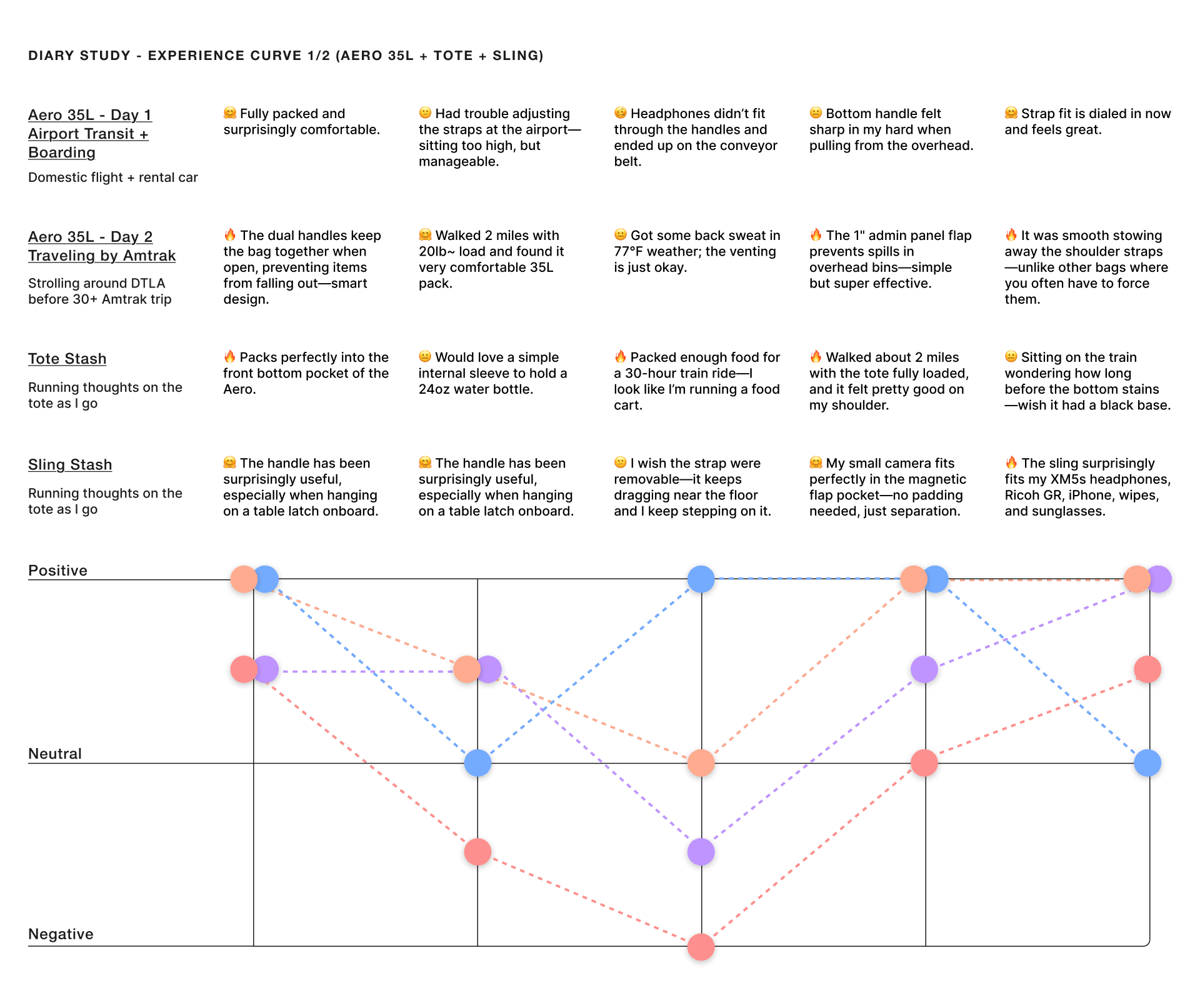
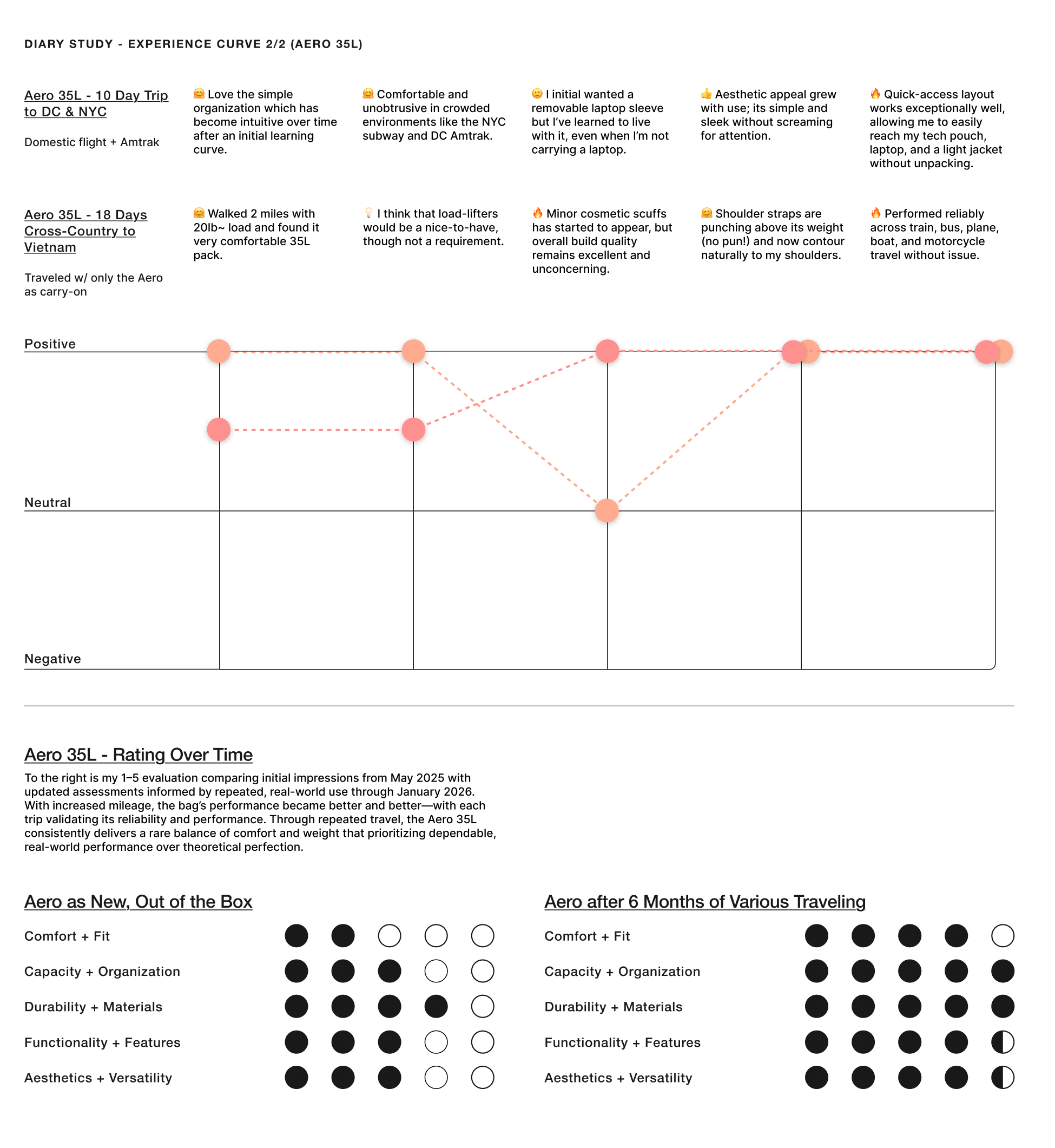
Which aspects improve, degrade, or remain consistent over time?
How does the usability and comfort of the Aero 35L evolve with repeated, real-world use?
How effectively does the bag balance comfort, weight, and capacity in active travel scenarios?
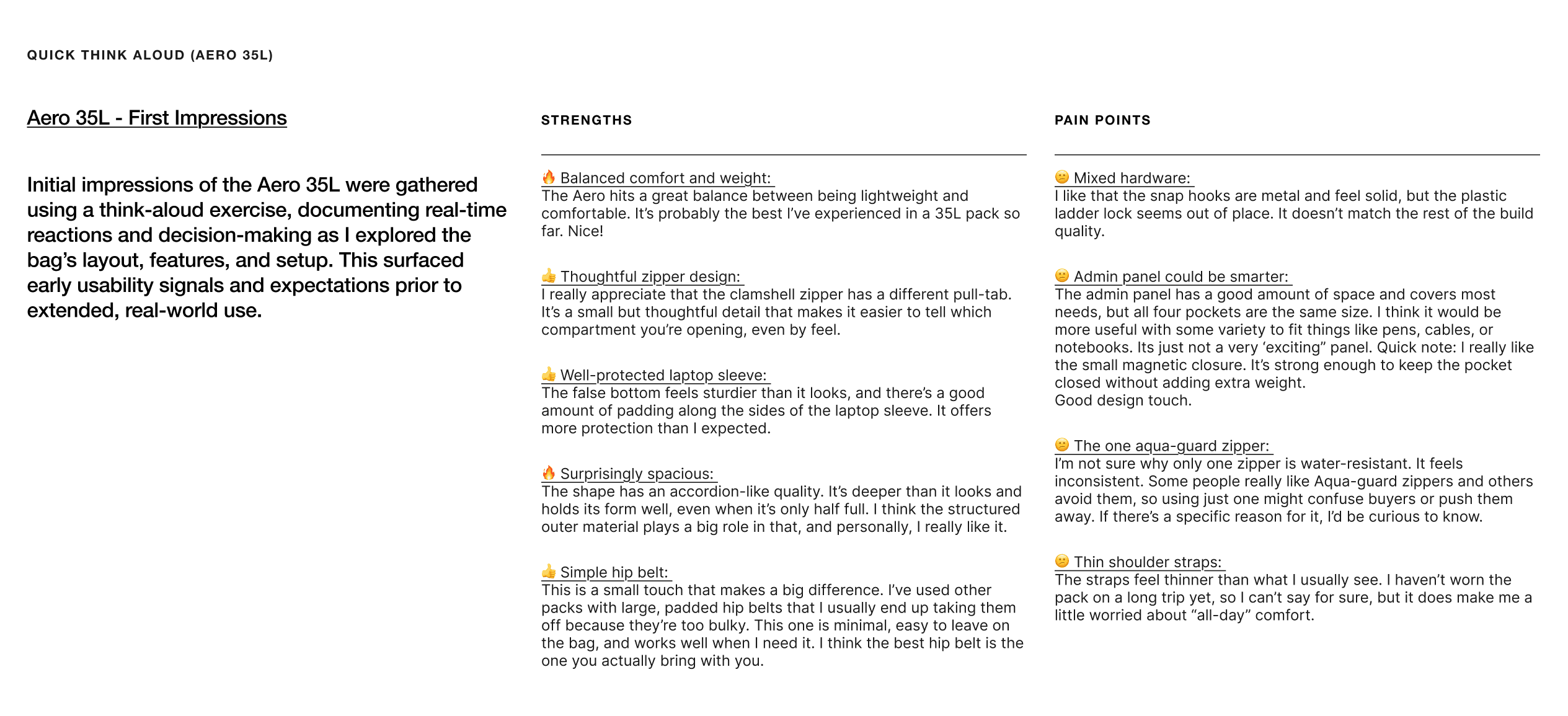
What frictions emerge during initial interaction, and which resolve naturally through use?
Research Approach
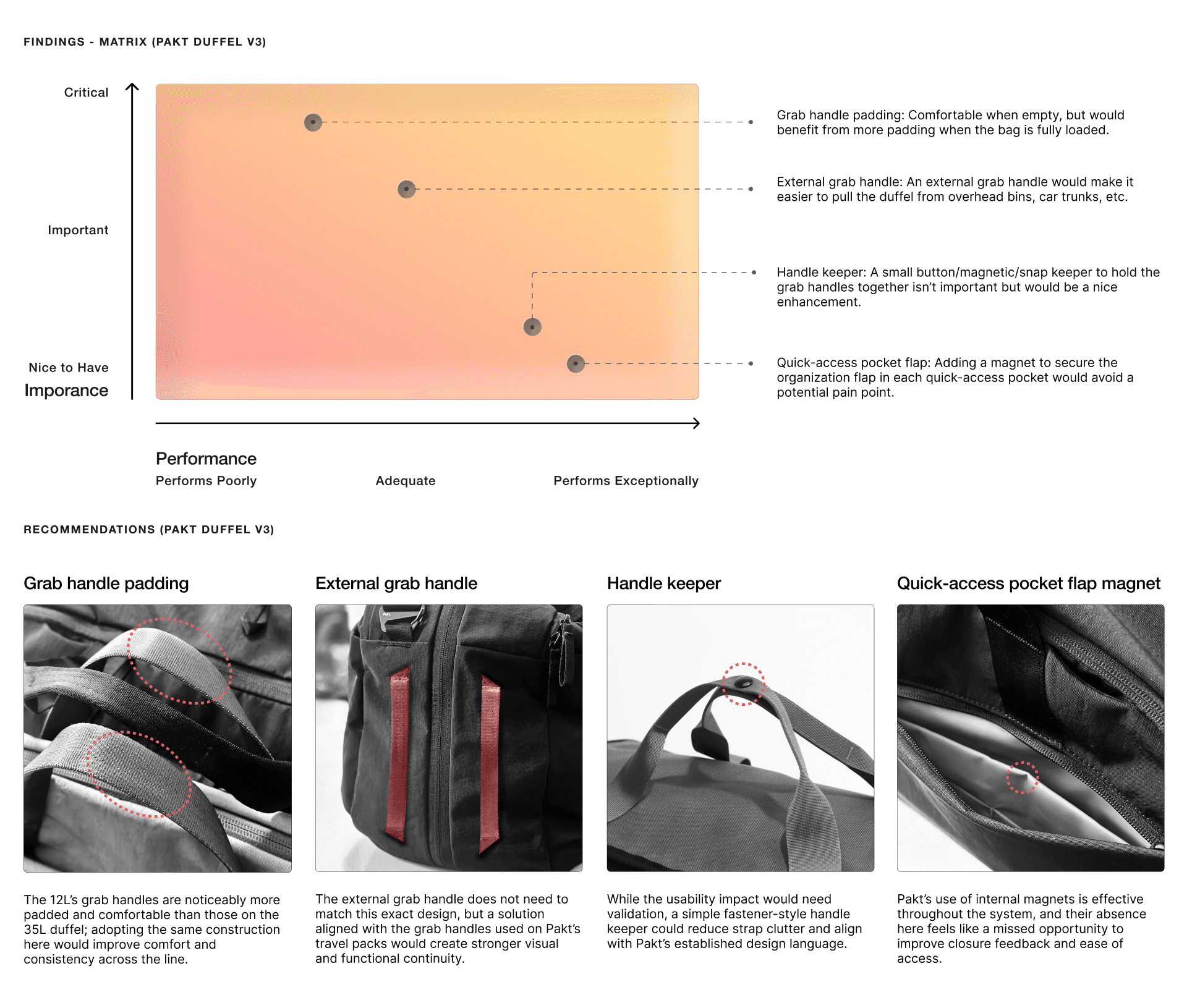
I used a mix of qualitative methods to evaluate both first impressions and long-term performance. The study began with a think-aloud exercise to capture initial reactions and expectations, followed by in-the-moment field notes collected across multiple trips over several months. These observations were later synthesized to identify patterns and shifts in perception over time. Because the Duffel v3 was a pre-production product and could not be travel-tested, I evaluated it using a structured findings matrix, prioritizing critical, important, and nice-to-have attributes, supported by visual recommendations. This approach grounded insights in real-world behavior where possible, and structured analysis where not.
The Aero 35L was the primary focus of a longitudinal evaluation conducted across multiple trips over several months. Observations were captured in real time during daily use and travel, then synthesized to assess how performance and perception evolved over time. Lighter-touch observations were also collected for the sling and tote to contextualize the broader carry system, though the Aero remained the core of the study.
The Duffel v3 was evaluated as a pre-production model, limiting opportunities for real-world travel testing. Instead, I conducted a structured assessment using a findings matrix, documenting insights across critical, important, and nice-to-have categories, supported by visual recommendations to highlight opportunities for refinement.
Case Breakdown
Aero Travel Backpack
Duffel Bag v3
Closing Thoughts
This project demonstrates the value of evaluating products beyond first impressions through sustained, real-world use.
Across nine months, I tested the system in a wide range of contexts—from international travel (Los Angeles, New York, DC, Vietnam, Iceland) to everyday routines like grocery runs, farmers markets, and weekly foosball nights. This breadth of use revealed how performance evolves over time, not just at first interaction.
By combining initial usability assessment with longitudinal, in-situ testing, I surfaced insights that only emerge through repetition—how comfort holds up, how access patterns change, and which features become essential versus incidental. The findings reinforced the importance of prioritizing comfort, durability, and versatility over theoretical optimization, resulting in recommendations grounded in lived experience rather than assumption.
Home
Next Project →
© 2025 All rights reserved
Sites
Work
Profile
Archive
Contact
Substack